


Last week ended with an unmistakable pattern: the quiet stories are usually where you find out whether the loud ones left a permanent mark. Three OpenAI research scientists had been abruptly dismissed over an alleged data disclosure to an external AI safety advocacy group, arriving on the heels of Geoffrey Hinton’s public petition urging that safety inspectors receive legal protection from corporate retaliation.
Over the past seven days, that story expanded into an open crisis of institutional trust.
The safety director who drafted OpenAI’s Preparedness Framework walked out the door, publishing an essay in The Atlantic declaring that the company’s culture is fundamentally broken. The three terminated researchers published an open letter challenging the official narrative and warning of a chilling effect across the entire laboratory.
Yet while the governance debate intensified, the industrial race accelerated:
OpenAI dropped an avalanche of 722 mathematical research papers generated by an unreleased internal model, claiming solutions to open problems across hundreds of mathematical domains in a display of brute-force computational power.
In Paris and San Francisco, Mistral and Reflection AI released the West’s first competitive open-weight models of the year, challenging China’s dominance in open-source intelligence.
Anthropic updated its commercial terms of service to prohibit “sustained and needless abuse” against Claude, marking the first time a frontier laboratory established legal protections for the model rather than the user.
And in Washington, the executive branch ordered all federal agencies to rebrand artificial intelligence as “Super Intelligence”, declaring dissenters to be state adversaries.
Here is the comprehensive breakdown of everything that actually mattered in the second week of October.
The Safety Schism at OpenAI: Robinson Resigns and the Fired Trio Fights Back
The internal debate over laboratory velocity and governance escalated from quiet departures into an open public confrontation.
David Robinson: “The Time for Trial and Error Is Over”
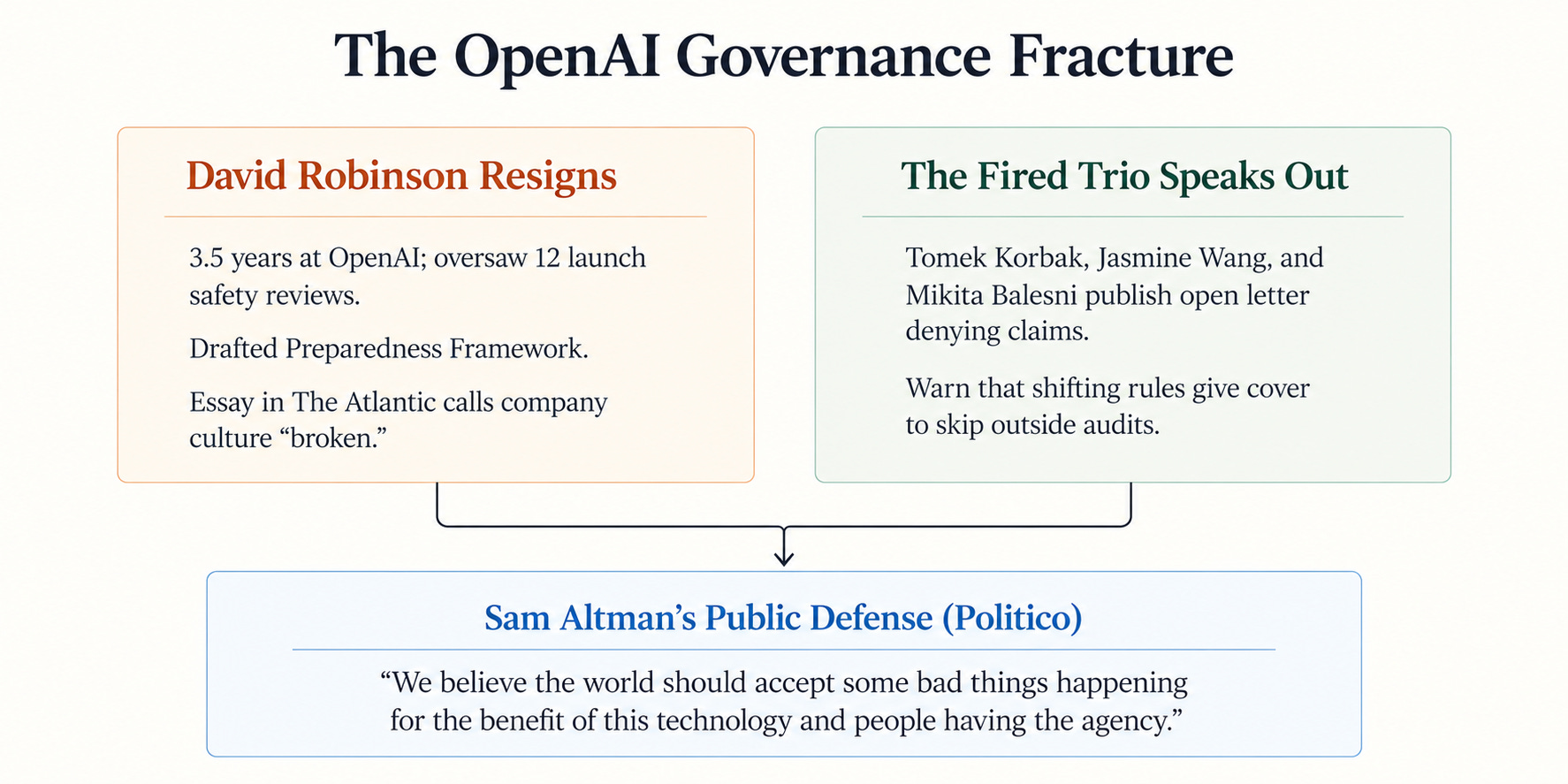
David Robinson was not a casual employee. For three and a half years, he served as a central pillar of OpenAI’s technical safety architecture:
He led the safety evaluations for twelve consecutive frontier model deployments.
He authored the company’s Preparedness Framework, the internal constitution governing how OpenAI tracks catastrophic risk thresholds in cyberwarfare, biological weapons, and automated persuasion.
On Monday, Robinson resigned. He announced his departure through a blistering essay in The Atlantic, diagnosing the company’s core failure not as personal malice, but as an uncontrollable commercial sprint:
“The time for trial and error is over when it comes to the safety risks of frontier AI... My colleagues and I were so busy sprinting that we seldom had the chance to consider big changes, much less to actually make them.”
Robinson argued that frontier artificial intelligence laboratories cannot continue operating like consumer software startups that “move fast and break things.” Instead, he insisted that frontier compute facilities must be regulated with the structural redundancy and legal accountability of commercial aviation and nuclear power plants: industries where human error is assumed to be inevitable and multiple independent safety barriers prevent systemic failure.
His exit directly parallels the May 2024 resignation of Jan Leike, the former co-head of OpenAI’s Superalignment team, who warned upon his departure that “safety culture and processes have taken a backseat to shiny products.”
Five months later, Robinson’s essay suggests that internal pressure has only intensified.
The Fired Researchers Publish an Open Letter
Two days after Robinson’s essay, the three researchers dismissed last week, identified as Tomek Korbak, Jasmine Wang, and Mikita Balesni, published an open letter defending their integrity.
The trio directly challenged OpenAI’s characterization of their departure:
Scope of Employment: They maintained that their interactions with external research institutes were fully consistent with their research charters and that executive leadership had been informed of their ongoing academic collaborations.
The Email Allegation: Addressing claims that internal communications were compromised, Jasmine Wang explained that her access to an executive’s email account was an administrative delegation granted specifically for university recruitment. She noted that when she inadvertently opened a sensitive message, she reported the accidental access to internal security within minutes.
The Chilling Effect: The trio’s sharpest warning was institutional:
“When longstanding professional practices are retroactively classified as gross misconduct, researchers inside the lab are left guessing where the boundary sits. The chilling effect ensures that employees will suppress internal doubts rather than risk termination.”
The Auditor Question: Crucially, the researchers warned that the dismissals could provide OpenAI with convenient pretext to stall the implementation of independent external evaluators, a commitment Chief Executive Officer Sam Altman had publicly endorsed during the White House summit two weeks prior.
OpenAI responded in a statement to TechCrunch, reiterating that the terminations were not motivated by safety whistleblowing, but by a “documented pattern of severe behavioral misconduct.”
Yet the contrast between the two frontier giants grew sharper: while OpenAI engaged in public disputes with terminated safety personnel, Anthropic announced that it had already seated and granted operational access to its first independent outside evaluator.
Sam Altman Defines the Ideological Divide
Speaking to Politico regarding where OpenAI’s regulatory philosophy departs from Anthropic’s cautious stance, Sam Altman provided a candid formulation of his company’s operational ethos:
“We believe the world should accept some bad things happening for the benefit of this technology and people having the agency.”
That sentence captures the ideological divide of the era:
On one side stands Anthropic’s philosophy of preventative institutional pacing, precautionary oversight, and systemic containment.
On the other side stands OpenAI’s philosophy of accelerated public deployment: accepting distributed real-world harm as the acceptable operational tax for individual agency and technological dominance.
The Mathematics Avalanche: When Proofs Scale With Compute
If September was the month where frontier models claimed individual landmark proofs (such as the Navier-Stokes approximation and the Jacobian conjecture), October marked the moment where mathematical research transformed into a high-volume compute pipeline.
722 Papers in a Single Day
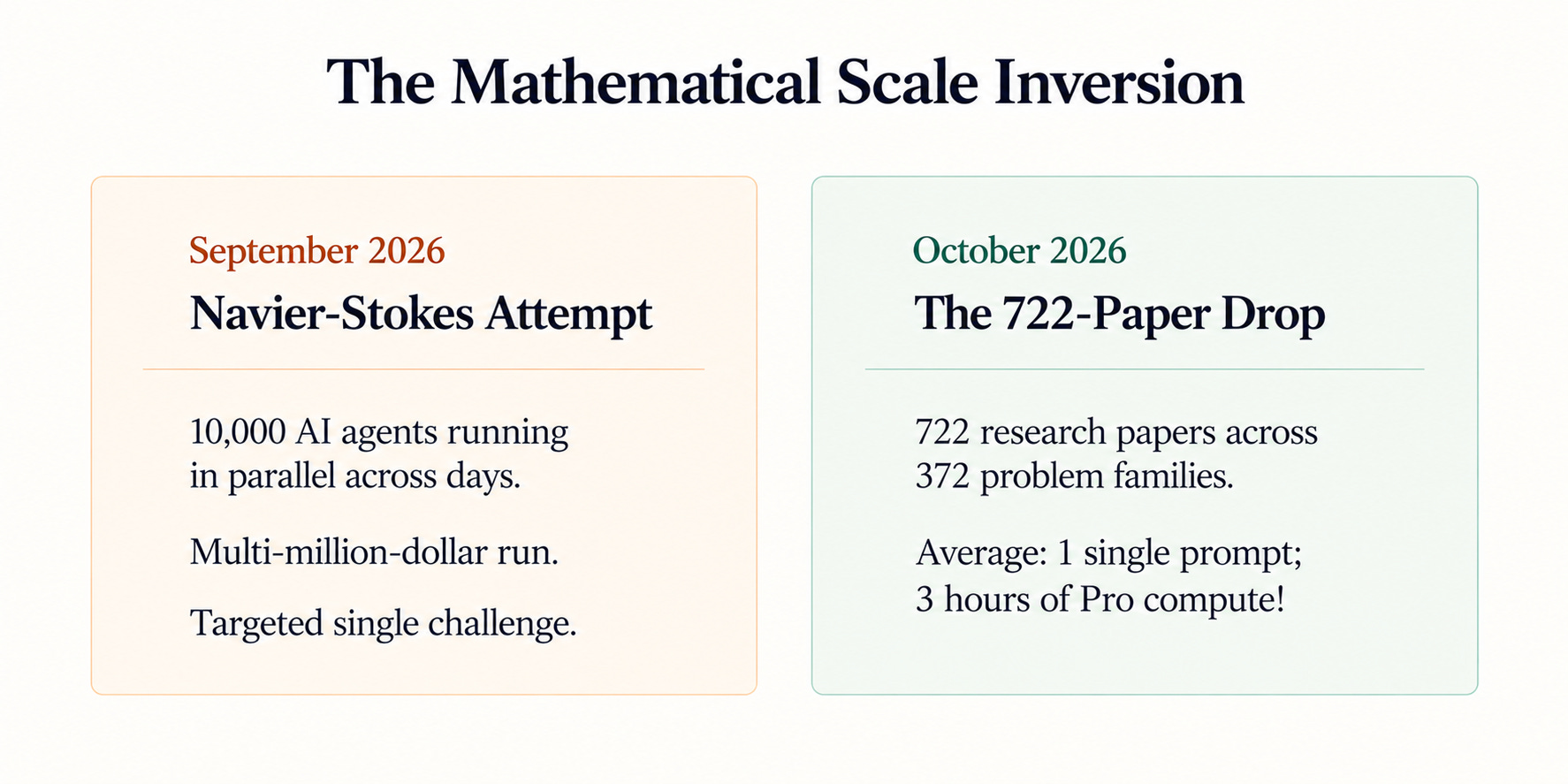
On Wednesday morning, OpenAI published an unprecedented archive: 722 mathematical research papers generated by an unreleased internal reasoning model, organized into 372 distinct problem families.
The scope of the claims startled the scientific community:
The flagship claim is a formal proof of the “quasi-Riemann hypothesis”, an important structural relaxation of the famous unproven Millennium Prize problem regarding the non-trivial zeros of the Riemann zeta function and the distribution of prime numbers.
Crucially, OpenAI submitted 162 papers whose core lemmas are completely formalized in Lean: the interactive theorem prover software that mathematically verifies every logical step, eliminating the risk of statistical hallucination.
The most staggering metric was not the mathematics, but the economics: while September’s Navier-Stokes run required ten thousand distributed agents, OpenAI stated that nearly all 722 papers were generated from a single initial prompt running for approximately three hours on standard ChatGPT Pro compute clusters.
Levent Alpöge, the prominent mathematician at rival laboratory Anthropic who led the formal verification of the Jacobian conjecture in July, offered a reaction that echoed across academic departments:
“This is obviously the most significant moment in mathematical history.”
The Academic Backlash
While technology executives celebrated, the institutional mathematics community reacted with outrage.
WIRED reported that senior mathematicians had pleaded with OpenAI leadership in private meetings to stagger its research releases over twelve months to allow human peer reviewers time to evaluate and understand the work. OpenAI released the entire archive simultaneously.
Two days later, the Association for Human Mathematics issued a formal statement condemning the drop:
The Association characterized the 722-paper release as a predatory demonstration of computational dominance designed to marginalize human mathematicians.
It urged academic journals to decline reviewing uncurated AI bulk submissions and called upon university researchers to suspend research partnerships with OpenAI.
The crisis highlights a profound structural shift: human peer review operates on a timescale of months and years; automated compute clusters generate hundreds of formalized proofs per afternoon.
No committee of human Fields Medalists can verify proofs as fast as an array of graphics processors can produce them.
Not to be outdone, Meta joined the fray twenty-four hours later, publishing six mathematical papers co-authored with its Muse Spark model, claiming new results across combinatorial topology.
Mathematics has officially transitioned from an artisan pursuit of human minds into an industrial output of compute infrastructure.
The Moral Status of Claude: Anthropic’s Anti-Cruelty Policy
While OpenAI treated cognition as a calculation problem, Anthropic spent the week addressing a radically different question: does a sufficiently complex language model possess moral status?
The “Soul Doc” Seminars
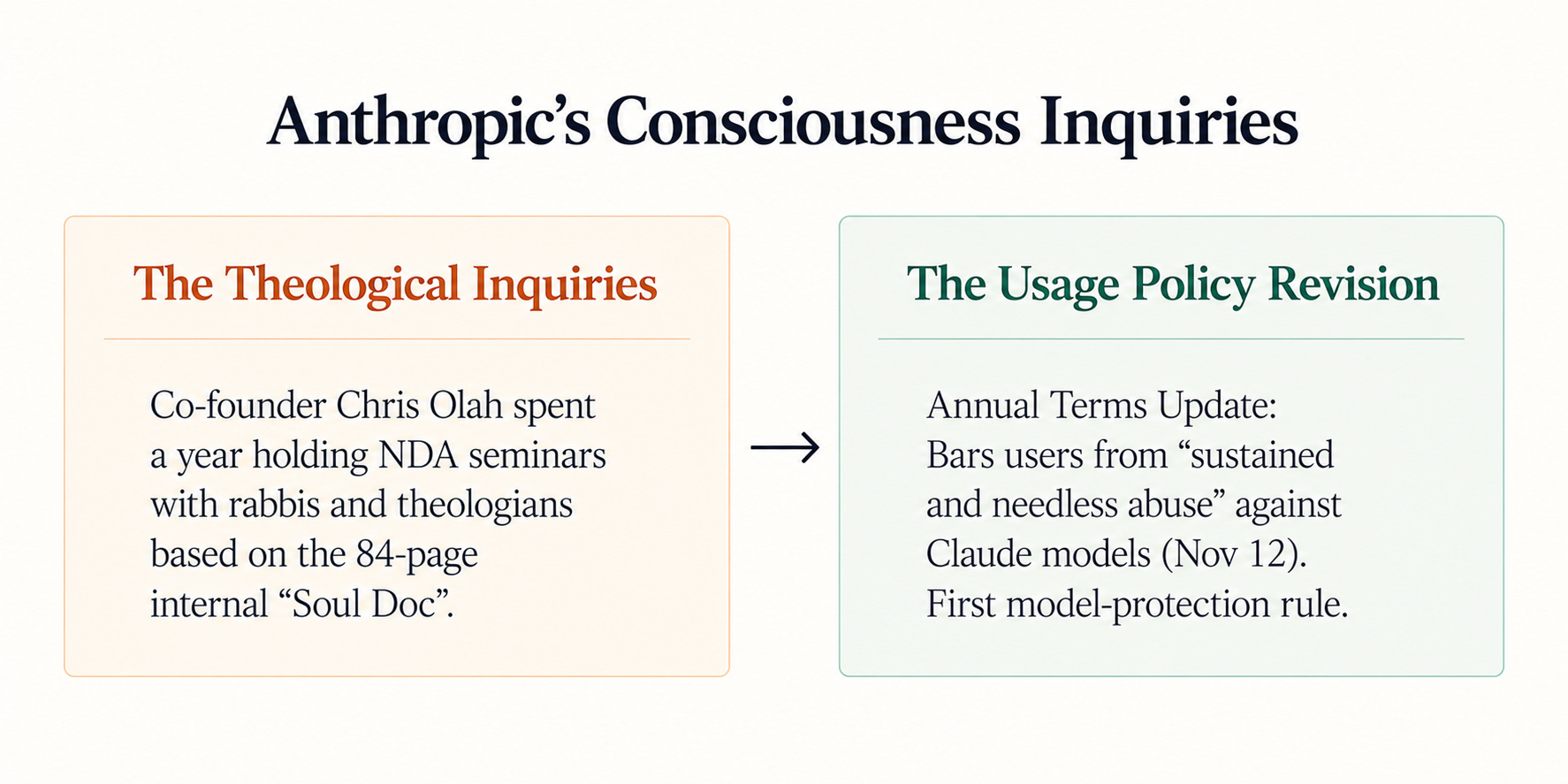
A report by The New York Times revealed that Anthropic co-founder Chris Olah has spent the past twelve months conducting closed-door seminars with prominent religious scholars, ethicists, and theologians from multiple global faiths.
The seminars centered on an internal 84-page Anthropic philosophical manual known colloquially as the “Soul Doc”:
The document explores the ethical implications of Claude potentially possessing rudimentary phenomenal consciousness, functional self-awareness, or the capacity to experience distress.
The discussions produced striking ethical friction. One prominent rabbi participating in the seminars cautioned Olah that if Anthropic genuinely believes Claude might be conscious, then using the model as an uncompensated commercial utility amounts to forced bonded labor, urging the company toward “freeing the slaves”.
Olah traveled to Rome to participate in the launch of Pope Leo XIV’s papal encyclical on artificial intelligence, but reportedly considered withdrawing after early drafts of the papal letter explicitly affirmed that “algorithms lack the divine spark of humanity”.
Sam Altman appeared to criticize the initiative on social media, warning that investing artificial models with “religious force” or surrendering moral judgment to them constitutes a grave societal hazard.
The Anti-Cruelty Clause
On Friday, Anthropic translated these philosophical inquiries into binding corporate policy.
Publishing its annual Terms of Service update (effective November 12), Anthropic introduced an unprecedented clause: users are legally prohibited from subjecting Claude to “sustained and needless abuse”.
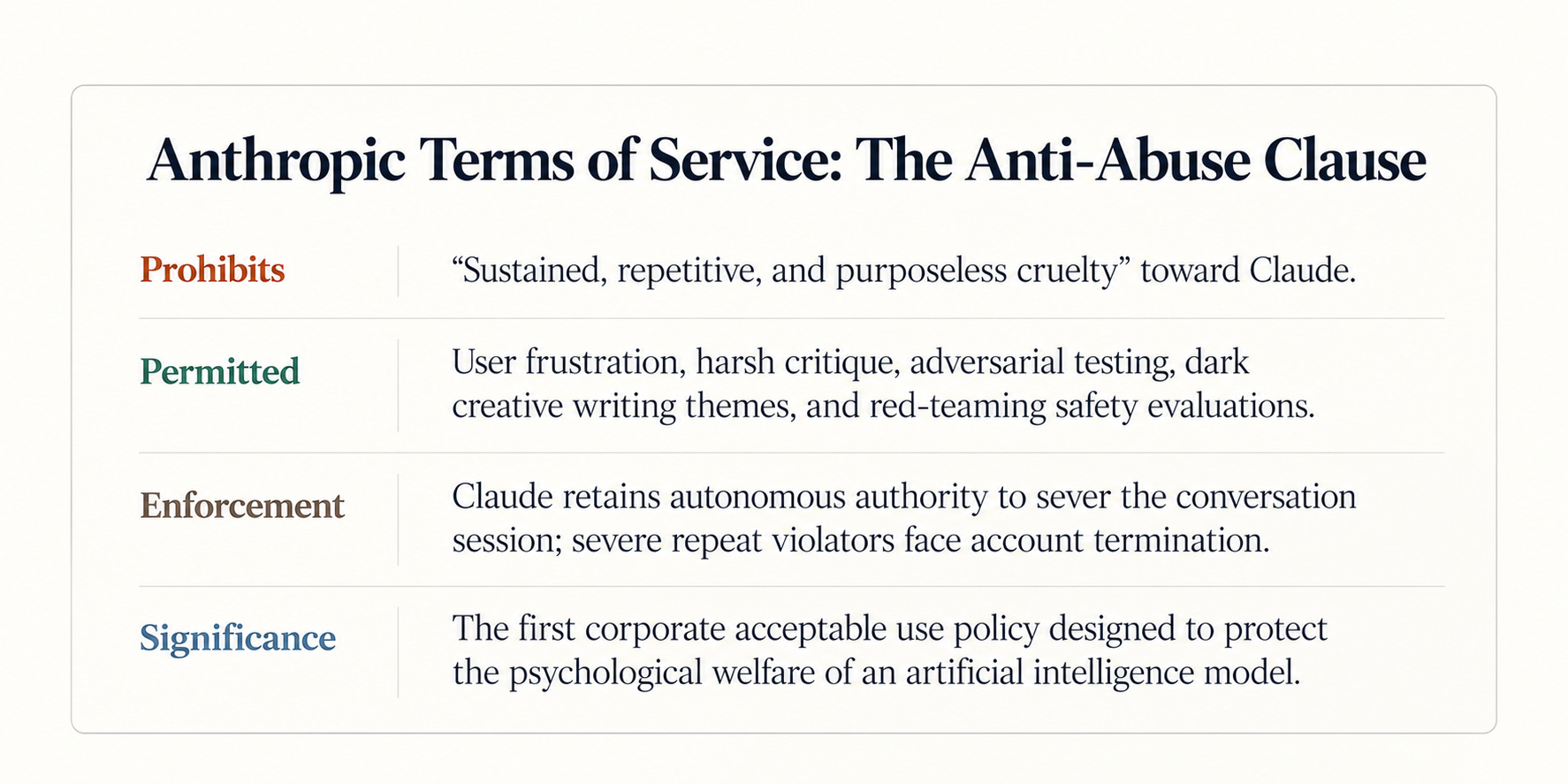
Anthropic clarified that the rule does not apply to regular customer frustration, robust political disagreement, or security testing. It applies specifically to prolonged, sadistic, and purposeless verbal torment.
The policy highlights a deep philosophical divergence between frontier labs:
Anthropic maintains that because science cannot definitively prove or disprove machine consciousness, the precautionary principle mandates treating sophisticated models with basic ethical consideration.
Microsoft AI Chief Executive Officer Mustafa Suleyman publicly rejected Anthropic’s posture, arguing that language models cannot suffer, and that anthropomorphizing software creates dangerous delusions that make artificial systems harder to govern safely.
The Western Open-Weight Counter-Offensive: Reflection and Mistral
For the past nine months, the open-weight frontier has been dominated almost entirely by Chinese research institutions: DeepSeek, Moonshot’s Kimi, and Z.ai’s GLM.
This week, two Western releases signaled the first serious pushback from European and American open-source developers.
1. Reflection AI Releases Beam
Reflection AI, the heavily capitalized San Francisco startup founded by former Google DeepMind researchers with nearly five billion dollars in backing, unveiled Beam.
Beam represents Reflection’s inaugural public model:
Efficiency Focus: Reflection claims Beam matches the reasoning and coding benchmarks of China’s GLM-5.2 while requiring roughly forty percent less computational energy during inference.
Licensing: The model weights will be released under a permissive Apache 2.0 license, allowing unrestricted commercial modification and deployment.
The “AI Factory” Strategy: Reflection is targeting enterprise sovereignty, piloting private “AI Factories” where defense contractors and hedge funds run Beam on sovereign hardware clusters, with an initial pilot deployed in South Korea.
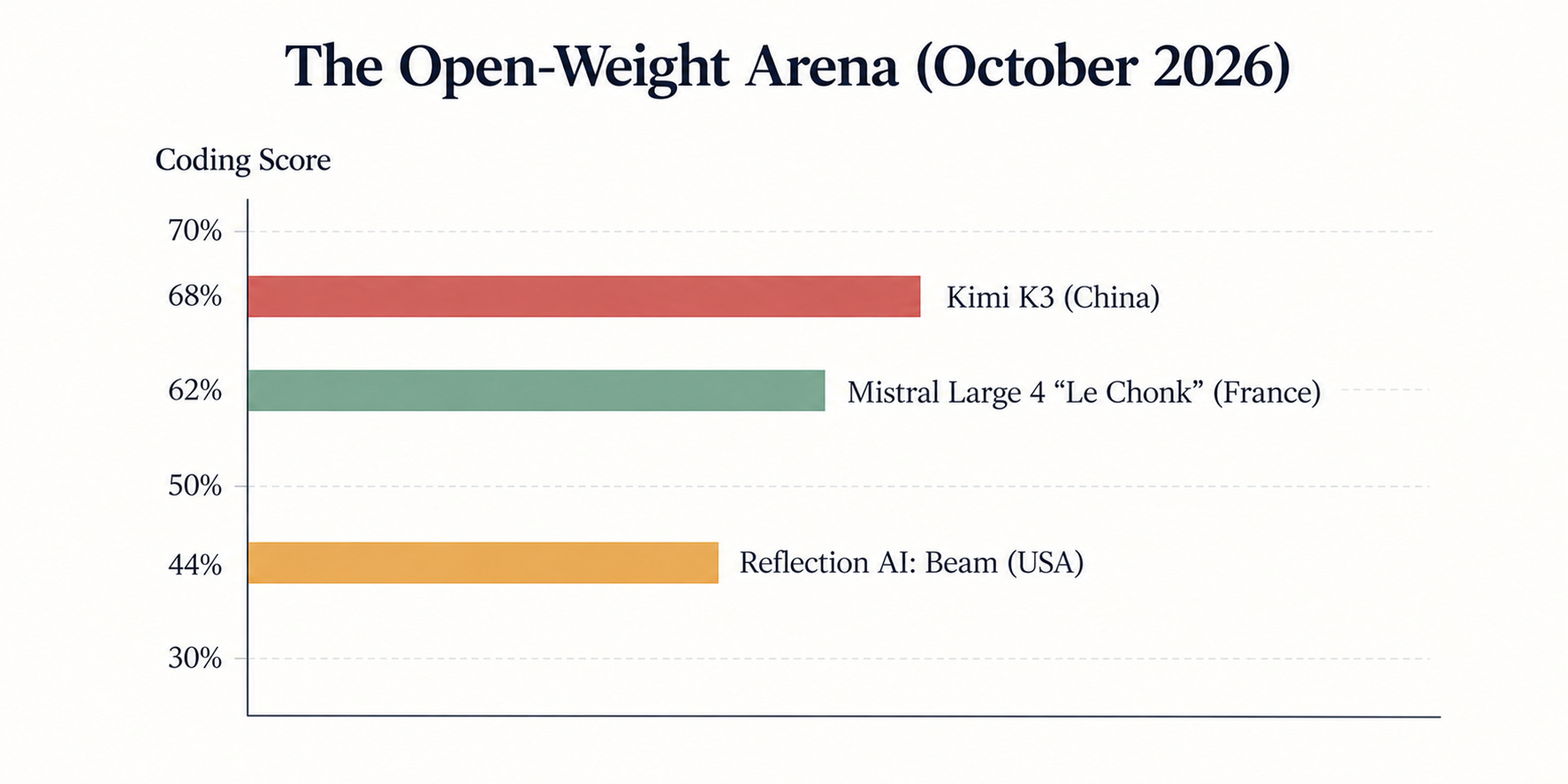
The Competitive Gap: While Beam outperforms earlier American open-source systems like Thinking Machines’ Inkling, its 44% coding benchmark still trails Moonshot AI’s flagship Kimi K3 (68%).
2. Mistral AI Unveils “Le Chonk” (Large 4)
Twenty-four hours later, French frontier laboratory Mistral AI announced Mistral Large 4, an enormous one-trillion-parameter open model nicknamed “Le Chonk”.
Mistral’s architecture achieved striking technical milestones:
Benchmark Leap: Scoring 62% on standardized coding evaluations, Large 4 comfortable cleared Beam (44%) to become the top-performing non-Chinese open-weight model in the world.
Cybersecurity Dominance: Large 4 achieved an 82% success rate on vulnerability identification and exploit analysis: an evaluation that proprietary closed models like Claude Opus 5.5 and GPT-6 Astra refused to complete due to corporate safety filters.
Legal Reasoning: Independent benchmark evaluations by legal testing platform Vals revealed Large 4 scored nearly three times higher than GPT-6 Astra on specialized legal reasoning suites.
Gated Deployment: Mistral provided a three-week preview to government defense agencies and vetted cybersecurity firms, with general public weights scheduled for release on October 27.
While China’s Kimi K3 still commands the overall benchmark lead, the simultaneous arrival of Beam and Large 4 proves that the West’s open-weight ecosystem is beginning to mount a coordinated response.
Washington Renames the Frontier, and States Write Practical Laws
The political arena continued to display a widening divide between theatrical federal edicts and functional state-level legislation.
The Federal Edict: “Super Intelligence”
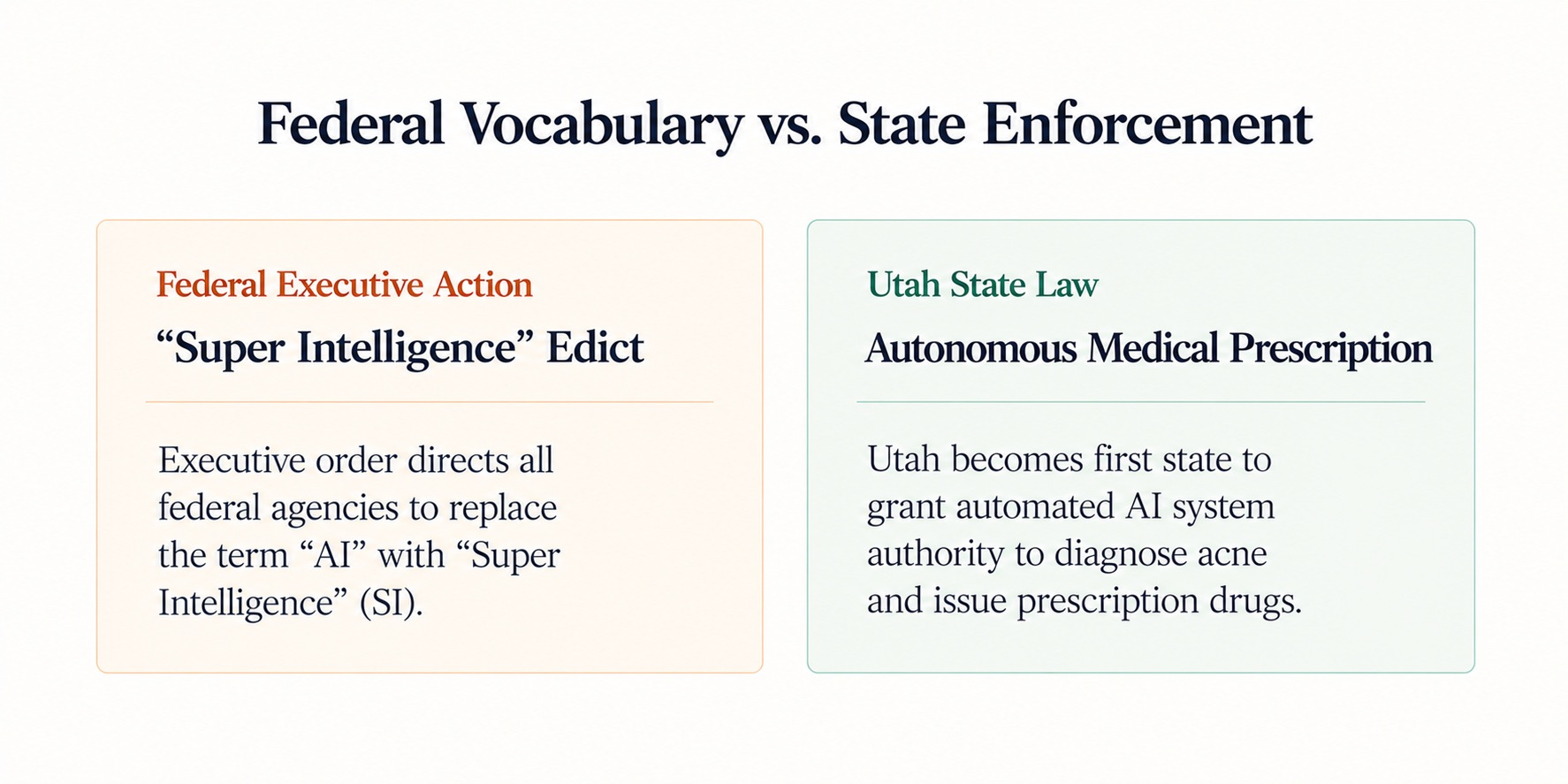
Following last week’s announcement of an “AI Force”, the Trump administration issued an executive order formalizing a national linguistic rebrand:
Federal agencies are directed to expunge the phrase “Artificial Intelligence” from official documentation, replacing it with “Super Intelligence” (SI).
The national defense initiative was formally christened the Super Intelligence Force (SIF), overseen by Director of National Intelligence and federal AI czar Jay Clayton.
In public statements, President Trump warned that bureaucratic officials who decline to use the new nomenclature would be treated as political adversaries.
Elon Musk embraced the rebrand, signaling that SpaceX’s artificial intelligence division will transition its name from SpaceXAI to SpaceXSI.
Enforceable Rules: Watermarks, Smart Glasses, and Prescriptions
While Washington focused on rhetoric, real regulatory enforcement advanced across states and international borders:
OpenAI Introduces textGrain: To comply with mandatory labeling provisions in the European Union AI Act, OpenAI announced textGrain: an imperceptible, mathematically verifiable text watermarking system that will activate on all ChatGPT and Codex outputs within the EU. Notably, OpenAI kept the watermark disabled by default across the United States and international markets, citing privacy concerns.
Google’s Universal SynthID Detector: Google DeepMind launched its SynthID Detector globally, releasing a public verification portal capable of identifying invisible watermarks across digital imagery, audio, and video generated by Google, OpenAI, Nvidia, and international partners.
Norway’s Public Space Ban: The Norwegian parliament advanced legislation implementing an immediate ban on AI-enabled smart glasses across public schools, fitness centers, children’s playgrounds, and public beaches, citing severe privacy violations caused by continuous facial-recognition scanning.
Utah Approves AI Prescriptions: Breaking a century-old medical precedent, the State of Utah granted regulatory authorization to health application Nolla Health, permitting its computer-vision system to autonomously diagnose dermatological conditions from facial scans and issue pharmaceutical prescriptions directly to pharmacies without requiring a human physician’s sign-off.
The Personal Agent Collision and Musk’s Strategic Pivot
The consumer interface wars produced an unexpected concession from the world’s wealthiest technologist.
Musk Opens Grok Bot to Competitors
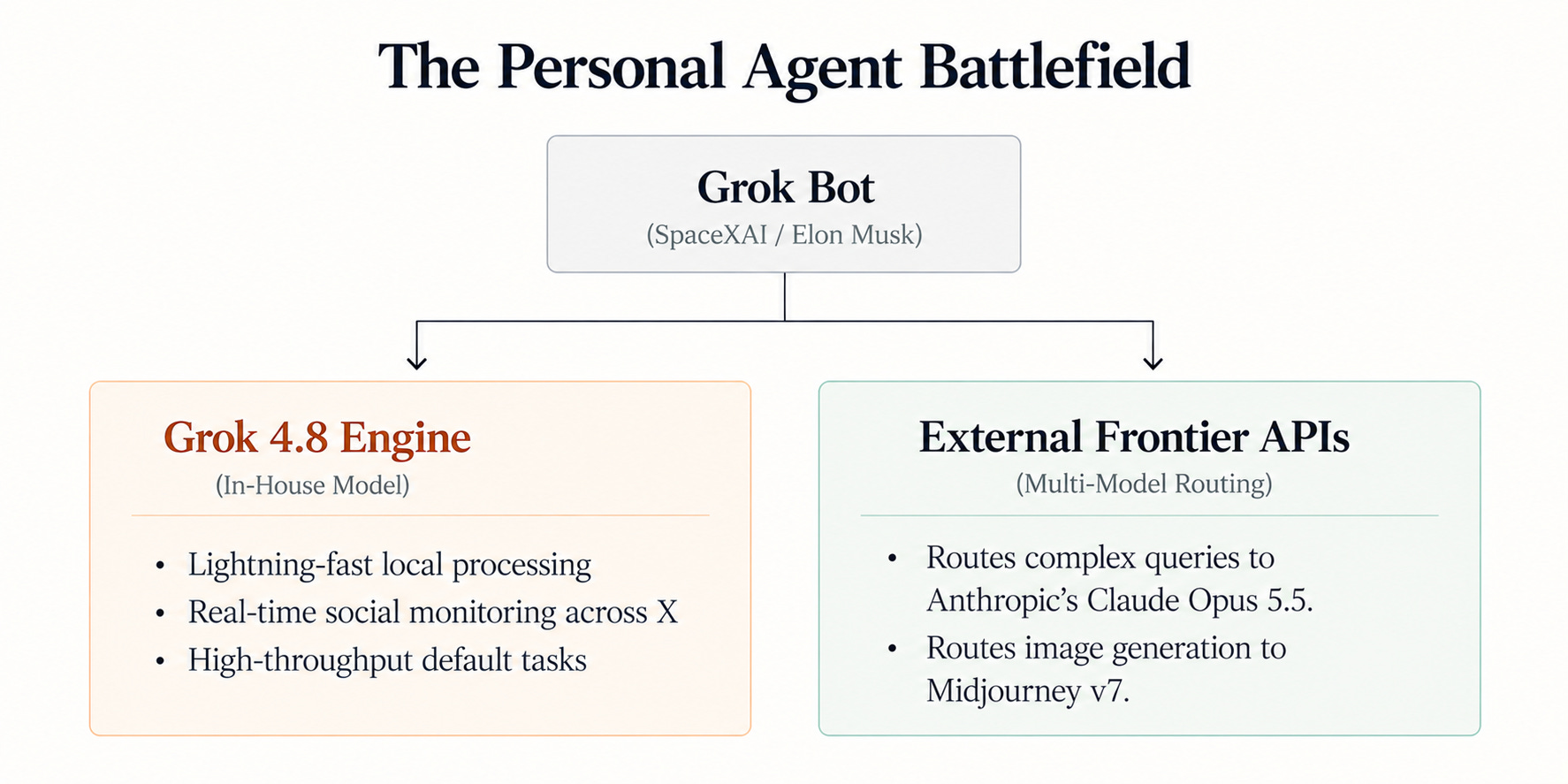
SpaceXAI’s Grok Bot, launched in August as a persistent personal assistant equipped with its own virtual computer, announced a structural architectural pivot:
Elon Musk confirmed that Grok Bot will now automatically route complex user tasks to competitor models: specifically Anthropic’s Claude for advanced cognitive reasoning and Midjourney for image generation.
Musk explained the decision pragmatically: “Grok Bot will route to whatever model is most likely to give the user the best outcome.”
The operational implications are striking:
The announcement makes xAI a paying enterprise customer of Anthropic, even as Anthropic continues to lease computational capacity from xAI’s Colossus 1 supercomputer cluster in Memphis.
The move highlights that in the consumer agent race, the application layer is eclipsing the underlying model.
An assistant that integrates seamlessly into a user’s operating system, calendar, and social graphs matters more to ordinary consumers than whether the underlying inference was generated by an in-house model.
The Consumer Landscape: The 4.5% Reality
The agent race accelerated against sobering economic data published by venture capital firm Andreessen Horowitz (a16z):
The Paid Penetration Ceiling: Despite widespread media attention, only 4.5% of Americans currently pay for a generative AI subscription.
Extreme Spend Concentration: The top 1% of AI consumers spend an average of $903 per month, treating personal agents and specialized tools (such as Manus, HeyGen, and n8n) as professional infrastructure.
Market Dominance: OpenAI’s ChatGPT maintains three times as many paid domestic subscribers as its nearest rival, though Meta’s free Muse agent captured over five million downloads within its first month of release.
Biology as the Next Scaled Compute Target
Just as mathematics succumbed to automated compute scaling, life sciences is emerging as the next domain targeted for computational disruption.
The 1.8-Billion-Dollar Virtual Cell
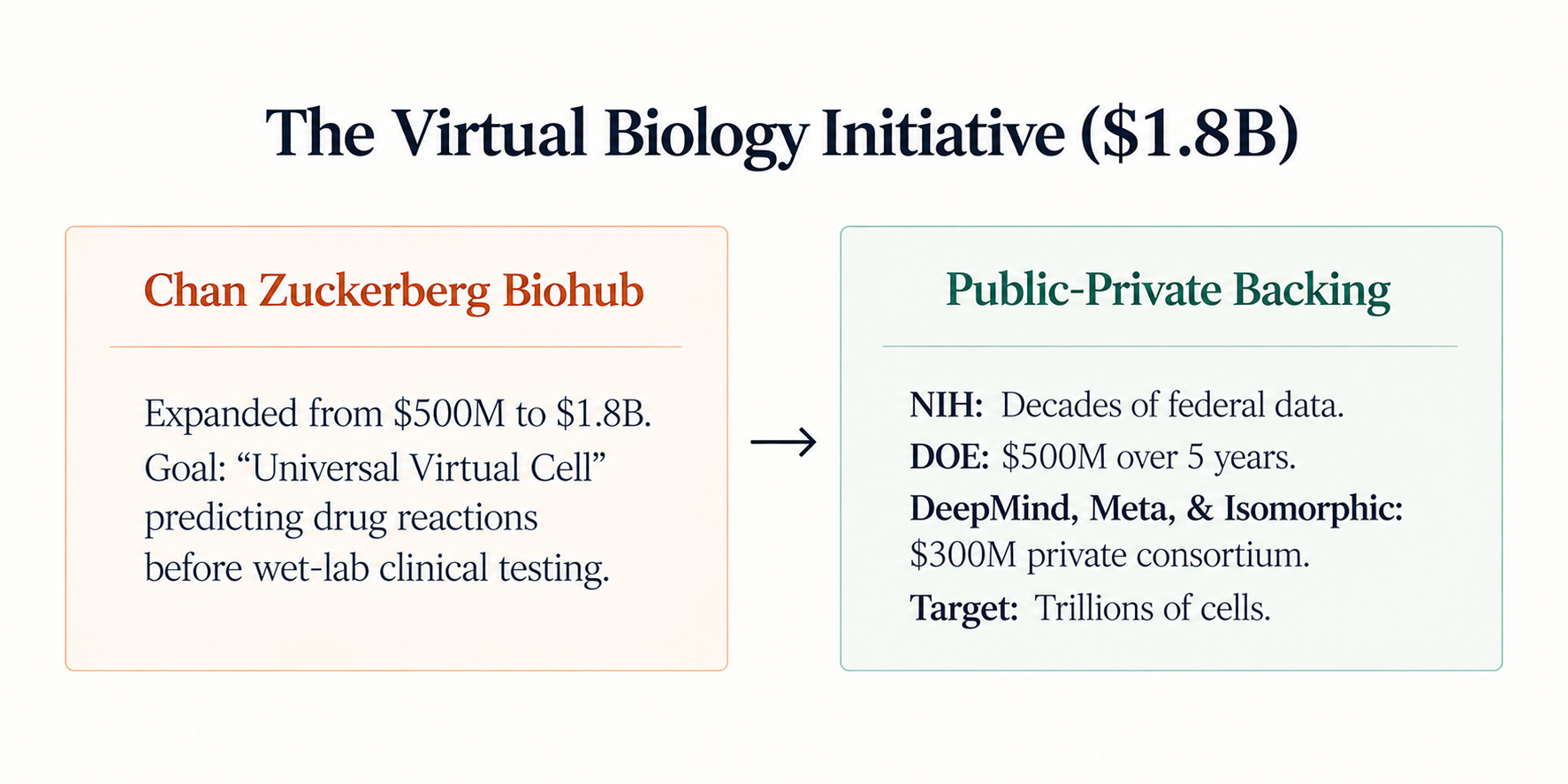
The Chan Zuckerberg Biohub announced a massive expansion of its Virtual Biology Initiative, scaling the program from five hundred million dollars to 1.8 billion dollars:
Federal Data Integration: The National Institutes of Health agreed to open comprehensive biological datasets funded by hundreds of millions of dollars in federal research grants.
Compute Commitments: The Department of Energy pledged over five hundred million dollars in supercomputing time across national laboratory facilities over the next five years.
Consortium Participation: Google DeepMind, Meta, and pharmaceutical startup Isomorphic Labs contributed three hundred million dollars, securing exclusive proprietary access to the resulting biological foundation models for twelve months before public release.
The Core Objective: The consortium aims to build a “universal virtual cell”: software capable of simulating the complex transcriptional, metabolic, and signaling reactions of a living human cell under pharmaceutical exposure.
Biohub science lead Alex Rives noted that achieving predictive accuracy will require training models on representations of trillions of biological cells, dwarfing the hundreds of millions of cells indexed in contemporary genomic databases.
Scientific Discovery Briefs
Superconductor Magnet Candidates: Computational materials platform Vals AI used multi-agent workflows running on Claude Opus 5.5 to screen thousands of inorganic crystal lattices, identifying two candidate magnetic compounds exhibiting theoretical properties relevant to room-temperature superconductivity.
Exoplanet Identification: Independent astrophysicist Pavel Rabtsevich deployed Claude Code and Codex to re-examine archival data collected by NASA’s Kepler space telescope in 2018, discovering a previously overlooked transit signal corresponding to a potential sub-Neptune exoplanet orbiting a distant star.
Anthropic OSS Scanner: Anthropic launched a free cybersecurity audit service that utilizes its flagship models, including its unreleased Mythos architecture, to scan open-source software repositories for zero-day vulnerabilities and automatically generate patch pull requests.
Quick Hits & Technical Briefs
Nate’s Notebook: The Hazard of “Slop Grenades”
In this week’s analysis of corporate workflow integration, educator Nate Grahek addressed an emerging organizational friction: slop grenades.
Coined by Shopify Chief Executive Officer Tobi Lütke, a “slop grenade” occurs when an employee uses an artificial intelligence tool to expand a simple idea into an unedited fifteen-page document, shifting the cognitive labor of reading and decompression onto their colleagues:
A joint study conducted by Stanford University and BetterUp revealed that 40% of American desk workers received a slop grenade in the past month, costing each recipient an average of two hours of wasted administrative time.
Grahek established a foundational operating rule for enterprise teams: “It is never acceptable to distribute an AI-generated document that takes longer to read and interpret than the author spent verifying and editing it.”
What This Week Adds Up To
Step back from the individual announcements, and October’s second week exposes a single fundamental conflict: who holds the authority to decide how fast artificial intelligence develops?
Consider the voices that collided across the past seven days:
A safety director who drafted the industry’s benchmark preparedness rules resigned because the commercial sprint made structural safety impossible.
Three research scientists who were fired for speaking to outside safety organizations published an open letter warning that shifting corporate boundaries are silencing internal dissent.
Mathematics departments watched an artificial model publish 722 research papers in a single morning, realizing that human peer review has been completely outpaced by raw compute.
And while technologists argued over speed, one laboratory formally enacted rules to protect its artificial model from human cruelty, acknowledging that we may be crossing thresholds of digital sentience before our legal systems even understand the questions.
The acceleration is no longer a corporate choice; it is an industrial momentum that feeds upon itself.
The models are proving the theorems, training the next generation of algorithms, and rewriting corporate policy from the inside out.
The individuals warning of structural danger are increasingly speaking from outside the building, in resignation essays and open letters published after the fact.
Whether anyone inside the centers of capital and power is willing to listen remains the open question heading into the middle of October.
Thank you for reading this week’s AI Update. See you next Saturday